YOUR SIMPLE GROWING PLAN
One pot. Here’s the plan.
Indoors, beside a bright window with room to spread. Start with nursery plant.
Choose a small plant in a draining 6–8-inch pot. Do not jump straight to an oversized planter.
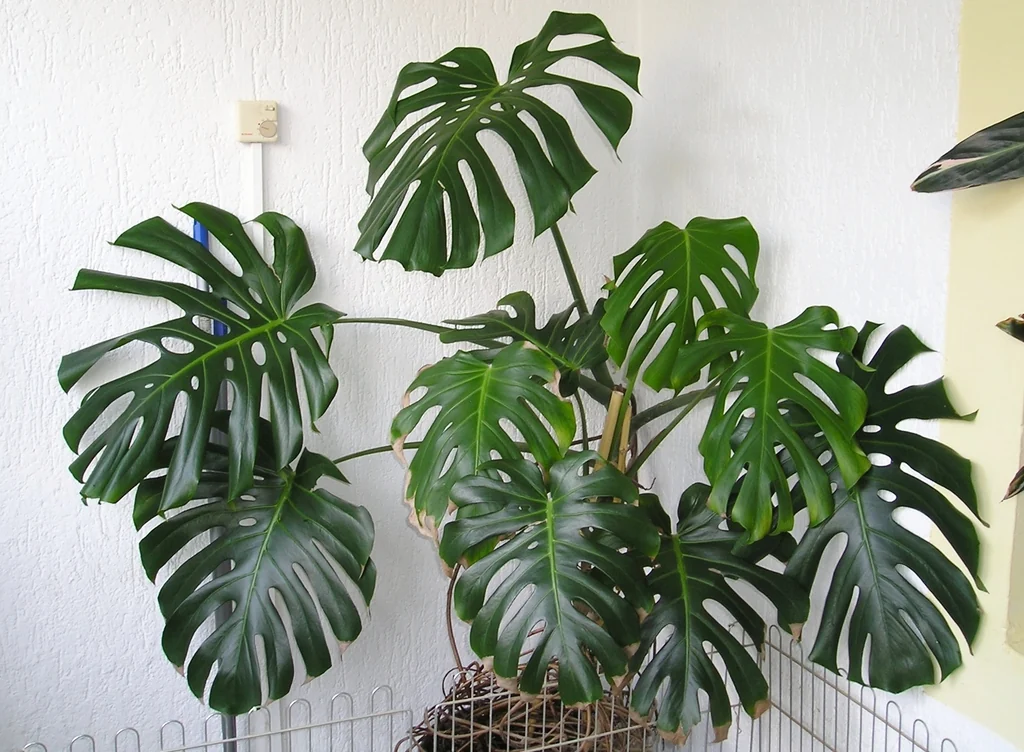
Start with a labeled green Monstera deliciosa, not a loose leaf.
- 01
Keep it in a draining pot
Give the nursery plant a stable base. Check that water can leave the inner pot and that the outer pot will not hold a hidden puddle.
- 02
Leave room beside a window
Place it where it gets bright indirect light. A young plant looks small, but mature leaves can spread well beyond the pot.
- 03
Feel the top of the mix
Check once a week. If the top 1–2 inches are dry, water until the root ball is wet and excess drains. If damp, check again later.
- 04
Support the main stem
As it grows, secure the main climbing stem loosely to a sturdy pole. Leave leaf stalks free to move; do not tie them tightly to the support.
Another way to start
Root a stem with a node+
Take a healthy stem section containing a node and its growing bud; a leaf and leaf stalk alone cannot make a new vine. Put the node in water with leaves above it, and replace cloudy water. Keep it warm in bright indirect light. Once several healthy roots and new growth develop, pot it into a small draining container of moist mix.
When to water.
Check weekly and use your finger to test the top 1–2 inches. Water only when that layer is dry; a cool or dim room can lengthen the wait. Water slowly around the root zone, allow drainage, and empty the outer pot. Persistently soggy soil is a reason to investigate drainage and roots, even if a leaf is yellow or drooping.
Exactly what to feed it.
Wait until any nursery or potting-mix fertilizer has finished. Feed an established plant that is actively making leaves. Skip extra food while roots are struggling, immediately after repotting, or when winter light has stopped growth.
½ TEASPOON PER US GALLON · EVERY 2 WEEKS
Miracle-Gro Water Soluble All Purpose Plant Food (US 24-8-16)
Mix ½ teaspoon of Miracle-Gro Water Soluble All Purpose Plant Food, US 24-8-16, into 1 gallon of water. Use at the roots every 2 weeks during active spring and summer growth, in place of a needed plain-water watering. Apply only enough to wet the pot and drain. This is the product’s indoor rate; do not use its stronger outdoor dilution.
Check the manufacturer’s product page ↗Use the named US formulation. A different product or concentration needs different directions. The amount mixed is a batch, not a dose to pour into one pot.
A little patience pays off.
New leaves may start solid and heart-shaped. Splits and holes usually become more pronounced as the plant matures with suitable light. A small cutting may take 2–3 months to make new leaves.
When should I start where I live?+
This is an indoor plan you can begin year-round. Warmth and good spring or summer light make establishment easier. Keep it away from frost, cold drafts, and intense sun through hot glass.
For regional planting windows, find your local Cooperative Extension office ↗.
Something looking off?
Why do the young leaves have no holes?+
Young Monstera deliciosa leaves commonly start without holes. Give the plant time, useful window light, and support. Adding extra fertilizer will not instantly produce a mature leaf.
Can I grow it from just one leaf?+
The cutting must include a piece of main stem with a node and growing bud. A leaf stalk without that stem node cannot grow into a complete new monstera.
Is this the same as Monstera adansonii?+
No. This plan is for Monstera deliciosa, whose mature leaves develop large splits and holes. Adansonii has a different leaf shape and growth habit; check the plant label when buying.
A little more growing know-how.
When a bigger pot is useful+
Look for a crowded root ball, rapid drying, or instability rather than repotting a new purchase automatically. Move up to a pot about 2 inches wider with drainage, and keep the stem at its previous depth.
A climbing plant needs a little help+
Keep the main stem supported as it gets heavier. Wipe dust from leaves with a damp cloth. Leave healthy aerial roots alone or guide them toward the support rather than forcing them into tight bends.
BEHIND THIS GUIDE
Where the advice comes from.
Plant care is based on the sources below. Planting layouts and beginner routines combine that guidance into one practical plan; they are editorial choices, not results from a Plant Care Steps growing trial.
- University of Minnesota: nodes, watering checks, and repotting ↗
- Penn State Extension: houseplant care and growing-season feeding ↗
- NC State: identity, support, and ingestion caution ↗
- Illinois Extension: feeding houseplants during growth ↗
- Manufacturer: US fertilizer formula and application directions ↗
Compiled with AI assistance. These first-edition guides have not yet had an independent horticultural review. Read our editorial approach.